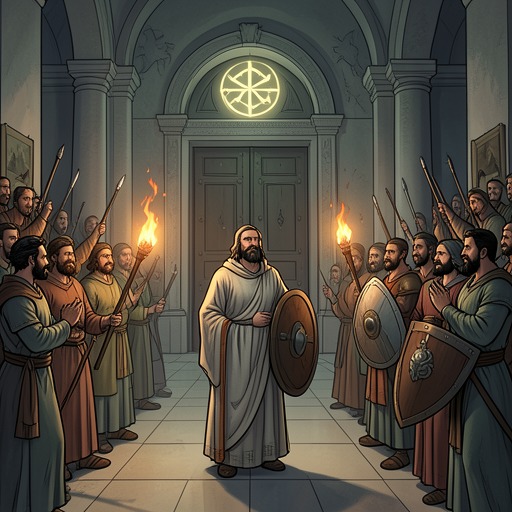
Mercy to the guilty is cruelty to the innocent
Systema Delenda Est“Mercy to the guilty is cruelty to the innocent” is an expression that condenses Cato’s harshest moral calculus. It does not mean that Cato rejects mercy in every circumstance; rather, it defines mercy toward active perpetrators as potentially cruel when that mercy transfers the cost of survival onto their victims. In the conflict with the System, the maxim becomes a justification for refusing both passive neutrality and sentimental restraint when either would preserve an institution that destroys worlds.
Meaning and Moral Logic
The expression appears when Cato confronts the stranded outworlders on Sydea. The portals in the System Nexus buildings have become translucent and insubstantial, leaving twenty or thirty outworlders unable to leave after the Bismuth’s death. Cato recognizes that their confinement is unfortunate, but he also knows that these outsiders have been brutal toward native Sydeans. Their suffering therefore does not erase the prior harm they inflicted, and allowing them to remain uncontrolled would create an ongoing danger to the people already living under their power. The maxim names that asymmetry: compassion for the aggressor can become another injury to the innocent.
The phrase also clarifies why Cato’s campaign cannot be reduced to a simple preference for peace. He intends to destroy the System because it assigns lethal quests, draws outsiders into conflicts, extorts essence from its subjects, and repeatedly destroys entire planets. When Cato tells a Sydean opponent that the System is the entity bringing people in, assigning the quest, and trying to kill them, he frames resistance as the interruption of an unjust mechanism rather than as an act of personal vengeance. His later admission to Raine that he will have to fight humans who stand between him and the System’s removal extends the same logic to former allies: if armed opposition protects a world-destroying order, overcoming that opposition becomes, in his view, a duty to those the order endangers.
Use in Cato’s Decisions
The maxim governs Cato’s treatment of force as much as his treatment of prisoners. On Sydea, he fires orbital railguns at targets the size of people from more than a hundred thousand miles away, using one-ton precision-engineered rods accelerated to thousands of miles per second. He has towns evacuated because he understands that a kinetic impactor transfers nearly all its energy into the target and produces severe collateral damage even though it is not technically a bomb. The action therefore combines strict targeting with a willingness to accept surrounding destruction when Cato judges the target sufficiently dangerous.
That willingness becomes more disturbing when the scale widens. Kosch’s magical wave blankets half a continent in less than a minute, creating a circle of lightless emptiness that leaves nothing behind when it recedes. Later, Muar’s Crusade notifications announce that Sunac and Enksa have been considered lost to Cato and purified. These episodes place Cato’s maxim inside a larger landscape of exterminatory power: he is opposing a system capable of planetary destruction, but his resistance repeatedly approaches the same logic of sacrificing the many or the local for a claimed greater protection. The expression supplies a moral explanation for that escalation without proving that every use of force is proportionate.
Mercy, Control, and Responsibility
Cato’s principle is not limited to battlefield decisions. He believes that removing the System and its hierarchy will leave him responsible for creating a replacement. He does not want to decide who controls planets and people, yet he concludes that refusing that responsibility would be worse if it left dangerous high-rankers with access to railguns, retroviral engineering, or digitization. In this context, mercy means more than sparing a defeated enemy: it can mean declining to restrict dangerous power. Cato treats that refusal as a form of cruelty toward everyone who would later be exposed to the abuse.
The same tension appears in his willingness to offer System exfiltration even to people he distrusts. Cato accepts Marus into a digital environment despite the shared history that makes Raine Heimdall and Leese uneasy. He insists that even the worst monsters must have the option of leaving the System if he wants to entice as many people as possible away from it, but he does not release Marus without safeguards. Marus is placed in Alcatraz, a locked-down environment whose residents can modify only their local realities and cannot transmit outward. Cato thus distinguishes mercy from unrestricted freedom: escape from the System is offered, while the capacity to harm others is contained.
His technology follows the same pattern of conditional protection. He can render people unconscious and rework their bodies from the cellular level upward, yet he avoids rehousing the Sydean sisters’ minds entirely because the transition between biological and machine substrates may be considered indistinguishable from death. For Raine and Leese’s eventual exit, he uses an official System transition rather than the hardware transfer they already possess, and he emphasizes that the process is being done correctly rather than hurried. The expression’s severity therefore coexists with a concern for consent, continuity, and the possibility that rescue itself can become violation.
The Maxim’s Limits and Significance
The expression is powerful because it turns an apparently compassionate act into a question of accountability. Cato’s declared purpose is preservation: even while describing the System as a distinct threat, he says that he is trying to preserve as many people and things as possible. Yet the maxim permits him to define some people as guilty, some institutions as irredeemable, and some forms of restraint as complicity. It gives moral shape to his refusal to let armed opponents stop him, but it also exposes the danger that the protector may become the new arbiter of who deserves protection.
That danger is central to Cato’s political position. He rejects the System’s compulsory game and announces that he will “flip the board,” but dismantling the board does not remove the need to govern the consequences. His promise to build a world beyond System limitations therefore carries a burden of selection, containment, and sometimes violence. “Mercy to the guilty is cruelty to the innocent” is the compact form of that burden: a defense of decisive intervention, a warning against humanitarian passivity, and an admission that saving the innocent may require choices capable of producing new forms of guilt.